

Cavapoos are the most oversold small dog in the world right now, and after six weeks living with two we understand why, and where the marketing stops matching the animal. A cavapoo is a cross between a Cavalier King Charles Spaniel and a Poodle, usually a toy poodle or miniature poodle parent.
We housesit, more than twenty pets in their own homes across Australia, Canada, the UK and Mexico. That gets you the unedited version of a breed: the 5am zoomies, the half-eaten dinner, the line in the handover notes that defines the fortnight.
Two of those dogs were cavoodles: a one-year-old we had for four weeks, a two-year-old we had for two. Here is the real size range, the exercise, the cost, the health concerns cavapoos inherit from both parent breeds, and why cavapoos are not the easy option they look like.

1. A Cavapoo Is Not a Breed, It Is a Lottery Between Two
Cavapoos are a first-generation cross, not a standardized breed. Major kennel clubs do not recognize cavapoos or other designer dogs, because a recognized breed needs generations of predictable type. Cross a spaniel with a poodle and you get a coin toss, repeated every litter.
Two puppies from one litter can land in different places: one with the poodle’s tighter curl and busier brain, the other with more pronounced spaniel features and the sink-into-your-lap stillness of the Cavalier. Both usually arrive with a similarly cheerful temperament, the one thing many designer breeds reliably deliver.
You cannot buy a personality off a website, only the odds. If a breeder cannot show you the poodle parent and the Cavalier parent in one visit, walk.
How cavapoos compare to similar breeds
Cavapoos are typically larger than maltipoos and more relaxed; maltipoos are often the more energetic. Cockapoos are larger again with more working drive. Against other mixed breeds and small companions like the shih tzu, the cavapoo’s edge is athleticism, its cost is coat maintenance.

2. The Teddy Bear Coat Is the Most Oversold Thing About Them
The living teddy bear look is real, but that teddy bear appearance is a grooming outcome as much as a genetic one. Cavapoos sport a fluffy coat running from loose spaniel waves to tight curls, and coat colors vary widely — ruby, blenheim, apricot, cream, black, chocolate and parti-colored.
Coat texture is a lottery too
Both of ours were absurdly soft: not silky like a Maltese, not wiry like a schnauzer, but dense and springy. Poodle like coats tend to keep growing rather than shedding out, which produces the plush density, and the mats behind the ears if you skip a fortnight.
Search “ugly cavapoos” and you will find owners whose adult dog grew out long-legged and straight-coated instead. The stuffed animal appearance on Instagram is usually a dog four days out of a groom.

3. How Big Do Cavapoos Get? Smaller Than the Photos Suggest
Cavapoos typically weigh 7 to 25 pounds (3–11 kg) and stand 9 to 16 inches (23–41 cm) at the shoulder. Toy cavapoos, from a toy poodle parent, weigh 7 to 13 pounds and stand 9 to 12 inches. Medium cavapoos, from a miniature poodle parent, weigh 13 to 25 pounds and stand 12 to 16 inches.
Size is the one thing a breeder can predict
Most cavapoos reach full size by twelve months, and the poodle side drives the variance, so an honest breeder will name the line and give you a range. Both dogs we sat were at the small end, and the first thing we each said, separately, was how little there was of them.
A cavoodle asleep between two adults takes up the footprint of a rolled towel. The average cavapoo weight sits in the low teens of pounds… genuine lap-dog territory!

4. They Are the World’s Fastest Couch Potatoes
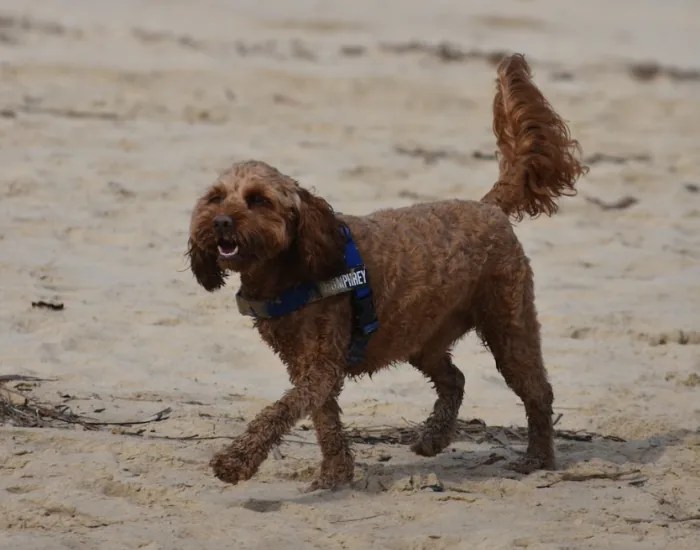
Cavapoos need 30 to 60 minutes of daily exercise across walks and interactive play, and that moderate exercise figure holds up. The one-year-old spent most of the day horizontal, took himself off for an hour of deliberate alone time, then exploded into ten minutes of zoomies and went back to sleep.
At the dog park he could genuinely move, cutting between much bigger dogs at a flat sprint, nothing on a greyhound, but the same burst-then-collapse build rather than the endurance engine of working sheepdogs. Cavapoos are not among the more athletic breeds in the canine world, but they are quicker than they look.
Heat, not distance, is the limit
He would walk a long way in the cool of the morning, then flatly refuse to go out under the sun, which in an Australian summer collapses your window to before eight and after six. Small dogs with dense coats overheat fast.
5. “Hypoallergenic” Is a Marketing Word, Not a Medical One
Cavapoos are not hypoallergenic, and neither is any other dog. Vredegoor and colleagues (2012) measured Can f 1 (the main dog allergen, in the hair and homes of breeds marketed as hypoallergenic, including poodles, and found no evidence for the label.
Why the low shedding coat myth persists
The confusion conflates shedding with allergens. The allergen lives in dander, saliva and urine, not the hair; a low shedding coat traps more of it against the dog. That is how the “non shedding poodle” idea becomes a claim about dog allergies the biology never supported, whatever the poodle ancestry.
Are cavapoos hypoallergenic enough for an allergic household? The only useful test is time in a room with adult cavapoos before money changes hands. Anyone selling hypoallergenic fur as a guarantee is uninformed or lying.

6. Grooming Is the Bill Nobody Warns You About
Regular grooming is not optional: brushing three times a week, professional cavapoo grooming every six to eight weeks at $60–$90, nails every four to six weeks, plus ear and eye cleaning, the Cavalier’s adorable floppy ears trap moisture and the poodle side grows hair inside the canal.
What happens when you skip a week
Cavapoo grooming needs escalate fast. The coat mats close to the skin where you cannot see it, and a matted dog gets clipped short rather than styled. We brushed both of ours, and the tangle difference between the wavier and curlier coat was obvious within days.
That makes cavapoos high maintenance in the only sense that matters: a recurring appointment and cost for twelve to fifteen years. It is the same trap people fall into with Maltese dogs and, less so, the wiry coat on a schnauzer.

7. One of Ours Never Barked. The Other Barked at the Television.
Cavapoos are generally quiet, which makes them good neighbors, but “generally” does real work there. The one-year-old was not a guard dog in any sense. The two-year-old barked at people at the front door, at birds, and — the only dog we have seen do this — at dogs on the television.
How to prevent nuisance barking
Neither was aggressive. This was announcement barking, and it stopped as soon as we acknowledged it. Nuisance barking in this cross traces to the spaniel’s alertness and to under-socialization; early exposure to people and other dogs is the cheapest insurance you will buy.

8. Their Digestion Is the First Thing We Would Ask a Breeder About
Both dogs we sat had unreliable bowels. The younger one’s stools were runny for four straight weeks despite no change of food; the older one had days where he did not go at all — enough of a swing that we flagged it with the owners.
Bryson and colleagues (2024) analyzed UK veterinary records for 985 cavapoos and found significantly higher odds of diarrhea and vomiting than in either poodles or Cavaliers. Cavapoos generally inherit a sensitive gut from somewhere in the mix.
They are fussy eaters, too
Neither dog was food-motivated. The older one, on fresh raw meat at the owner’s request, would carry a piece to another room and set it down without eating it. Raw feeding is contested and we cannot settle it. This is our experience and published research, not veterinary advice.

9. Hybrid Vigor Will Not Save You From the Health Inheritance
Crossbreeding does not reliably produce a healthier dog. Bryson and colleagues (2024) compared cavapoos, cockapoos and labradoodles against their purebred progenitors and found no difference in 88% of disorder comparisons — results that challenge widespread beliefs in hybrid vigor across designer breeds.
The health concerns come from both sides. From the Cavalier: myxomatous mitral valve disease, and syringomyelia, a painful spinal condition Parker and colleagues (2011) found in Cavaliers showing no clinical signs. From the poodle lineage: progressive retinal atrophy. And from both: patellar luxation and hip dysplasia.
Demand certificates, not assurances — cardiologist certification on the Cavalier parent, eye testing, patella scoring, and MRI screening for syringomyelia where the line warrants it.
What is a cavapoo lifespan?
Cavapoos are usually quoted at 12 to 15 years, but nobody has published longevity data for cavapoos specifically. McMillan and colleagues (2024) put median life expectancy for UK crossbreeds at 12.0 years and Cavaliers at 11.8, against 12.7 for purebreds. What cavapoos inherit depends more on which parents you drew than on the label.

10. They Are Excellent Family Dogs, And They Pay for It in Separation Anxiety
Cavapoos typically strike an easy balance with children, other dogs and other pets. Both of ours were superb at the dog park and dog beach: off-lead, no recall problems, an equally friendly dog with every stranger — which is why cavapoos get sold as natural therapy dogs, a claim that oversells what is really low suspicion.
Separation anxiety is the price of the affection
These dogs genuinely bond hard and are prone to separation anxiety. The two-year-old had to sleep in the bed, woke us before sunrise with zoomies across the duvet, and decided without malice that several of our belongings were chewable.
The younger dog took a week to warm to us, then one night arrived and slept belly-up between us. Jackie noticed the shift before I did. It says a lot about how these dogs approach life: they want proximity, not contact — and they fall apart in an empty house.

11. They Suit Apartments Better Than Almost Any Small Dog We Have Sat
o be fair, both of the homes we stayed in were huge, but the extra space went entirely unused. Wherever we were, the dogs were right underfoot. Cavapoos are good apartment dogs. And this one claim we will endorse without hedging. Both of ours were 100% indoor animals and neither needed a yard to be honest. The size is small, the noise level is low, and they care more about where you are than about patrolling territory.
One detail we did not expect: the younger dog would only ever toilet outside, never indoors, no lapses in four weeks. That has deep roots, wild canids keep the den clean, and pups instinctively move away from the sleeping area to eliminate.

12. The Price Is High and the Ethics Are Complicated
Cavapoo puppies typically cost $1,200 to $5,000 in the US, and cavoodles A$3,000 to A$8,000 in Australia. Beyond the sticker price from reputable breeders, monthly insurance runs $30 to $70, grooming $60–$90 every six to eight weeks, and lifetime costs reach $18,000 to $25,000.
High prices and no kennel-club oversight are the conditions that reward unethical breeding practices, puppy farms, unscreened parent dogs, no cardiac or ophthalmic testing. See the parents with the puppies, visit the premises, and walk away from anyone who wants to meet in a car park.
Check the rescues first
Breed specific rescues and small dog rescue organizations have cavapoo mixes waiting right now, and checking breed specific rescues costs nothing but an email. With an adult you see the coat, the size and the temperament before committing, and a deserving dog gets a home.

Is a Cavapoo Right for You?
Cavapoos suit people who are home a lot, live in a smaller space, and are honest about grooming. If you want an intelligent companion dog that sleeps against your leg while you work and greets every dog in the park like an old friend, this cross is hard to beat. They are charming canines, fluffy companions in the most literal sense.
Walk away if you are out all day, if you want a low-maintenance coat, or if you are buying on the promise of a hypoallergenic dog. Walk away too if the budget only covers the purchase price, or if you want a running partner in the heat, look at more athletic breeds.
Are cavapoos a good first dog?
Yes, with one condition. They are forgiving, eager to please and respond best to positive reinforcement, and the poodle’s intelligence shows early, though most owners meet the inner stubborn spaniel eventually, usually at the exact moment they want the dog to come back. These adorable dogs require commitment in year one: grooming, socialization and alone-time training.
Is a Cavapoo Right for You? 🐩
Eight honest questions, based on our six weeks living with two cavapos and the research. No fluff — you’ll get a real verdict, plus the specific things to watch.
Frequently Asked Questions
A toy cavapoo weighs 7 to 13 pounds (3–6 kg) and stands 9 to 12 inches (23–30 cm) when fully grown, reaching adult size by about twelve months. The toy label refers to the toy poodle parent, not a separate variety.
Grooming load, inherited health risks and separation anxiety. Coats mat without brushing three times a week plus professional grooming every six to eight weeks, and the cross can inherit mitral valve disease and syringomyelia from the Cavalier side, eye conditions from the poodle.
A toy cavapoo dog costs $1,200 to $5,000 in the US and A$3,000 to A$8,000 in Australia, smallest sizes priced highest. Insurance averages $30 to $70 a month, grooming $60 to $90 every six to eight weeks.
Most cavapoos are quiet, but variation is wide. Of the two we sat, one never barked and the other barked at the door, at birds, and at dogs on the television. Barking here is alert-based rather than aggressive, and early socialization prevents it.
The Verdict
Two dogs, six weeks, almost nothing in common but softness and sociability: one silent, one narrating the television; one solitary until he wasn’t, one welded to the bed. Buy the parents, not the breed, that lesson applies to every designer cross on the market.
Still shortlisting? Compare them against dogs bred for a job rather than a lap: the working brain of herding breeds, the terrier engine inside a schnauzer, or the indoor stillness of a retired greyhound. Lived with a cavapoo that broke the pattern? Tell us in the comments.
References:
Bryson, G. T., O’Neill, D. G., Brand, C. L., Belshaw, Z., & Packer, R. M. A. (2024). The doodle dilemma: How the physical health of ‘designer-crossbreed’ Cockapoo, Labradoodle and Cavapoo dogs compares to their purebred progenitor breeds. PLOS ONE, 19(8), e0306350. https://doi.org/10.1371/journal.pone.0306350
McMillan, K. M., Bielby, J., Williams, C. L., Upjohn, M. M., Casey, R. A., & Christley, R. M. (2024). Longevity of companion dog breeds: Those at risk from early death. Scientific Reports, 14, 531. https://doi.org/10.1038/s41598-023-50458-w
Teng, K. T.-y., Brodbelt, D. C., Pegram, C., Church, D. B., & O’Neill, D. G. (2022). Life tables of annual life expectancy and mortality for companion dogs in the United Kingdom. Scientific Reports, 12, 6415. https://doi.org/10.1038/s41598-022-10341-6
Vredegoor, D. W., Willemse, T., Chapman, M. D., Heederik, D. J. J., & Krop, E. J. M. (2012). Can f 1 levels in hair and homes of different dog breeds: Lack of evidence to describe any dog breed as hypoallergenic. Journal of Allergy and Clinical Immunology, 130(4), 904–909. https://doi.org/10.1016/j.jaci.2012.05.013
Parker, J. E., Knowler, S. P., Rusbridge, C., Noorman, E., & Jeffery, N. D. (2011). Prevalence of asymptomatic syringomyelia in Cavalier King Charles spaniels. Veterinary Record, 168(25), 667. https://doi.org/10.1136/vr.d1726
